
Digital Twin Products
World-leading city-scale slope digital twin
In his “Digital Twin” project, Prof. Zhang is set to further assist policymakers and the community in better forecasting and emergency response, leveraging the data analysis and technological advances opened up by the digital era, in particular AI, remote sensing, and augmented/virtual reality. One project goal is to deliver the world’s first comprehensive and versatile city-scale slope digital twin to sense, simulate, and visualize landslide hazard processes in order to coordinate how to respond. Prof. Zhang is also seeking to create a new model for managing hazard emergency risks that covers the “human response” aspect of landslide emergency risk management. This will be achieved through devising a digital twin-empowered common operating platform with an augmented reality environment for interactive decision-making, emergency management, as well as immersive public education.
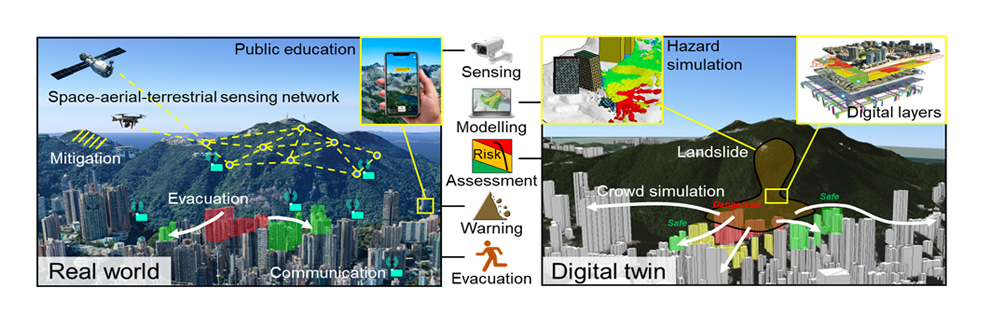
The digital twin project is seeking to enhance the disaster resilience of existing slope safety systems in Hong Kong and other regions by establishing an intelligent sensing system that integrates air, space and ground to monitor surface conditions and social activities and quickly identify landslides.
The partners involved are a testament to HKUST’s local and international standing, comprising the Chinese University of Hong Kong, the University of Hong Kong, the government’s Civil Engineering and Development Department, the University of California, Berkeley, and the Norwegian Geotechnical Institute. Meanwhile, the scale and essential contribution that Prof. Zhang’s project is set to make to the community and internationally have been fully recognized with the awarding of HK$73.945 million* in Hong Kong’s prestigious Theme-based Research Scheme 2023/24, the highest funding among the nine projects approved for this round of the Research Grants Council scheme.
To implement the cutting-edge project, Prof. Zhang is bringing together a multinational, cross-disciplinary team including experts from his own field of geotechnical engineering, as well construction informatics, computer science, remote sensing, emergency management, and public policy, among others. Challenges include moving from project-scale to a city-scale interactive simulation-enabled digital twin, extending slope-scale computational capabilities to city-scale real-time modeling, and developing dynamic risk-informed decision theory in complex urban settings.
“Engineering works always have an important role to play in managing natural disasters and extreme weather events,” Prof. Zhang said. “But in addition we need to take into account the human response. Therefore the strategy should be not only to prepare to mitigate extreme events, but to have thought ahead to emergency risk management as well.”