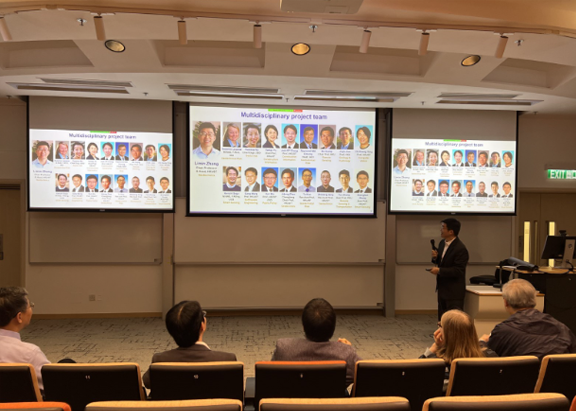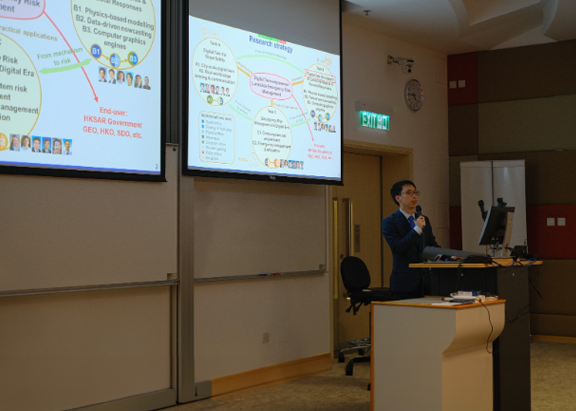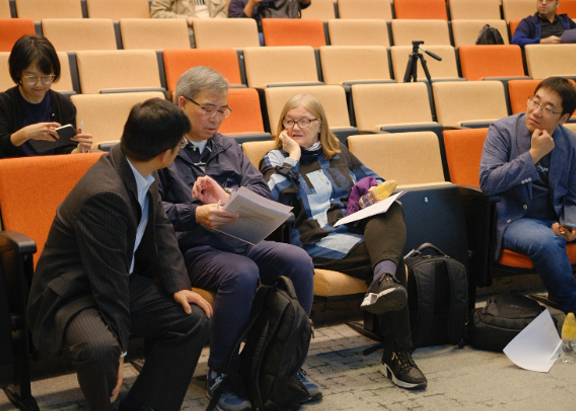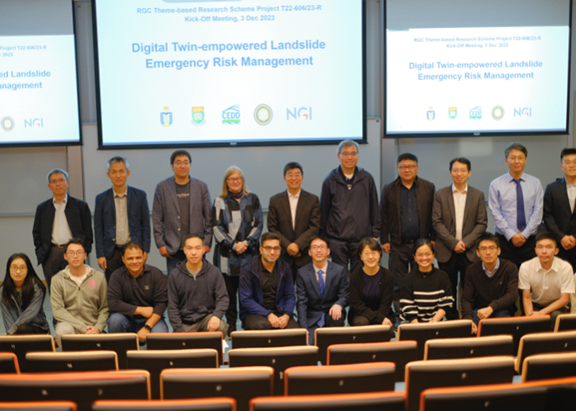
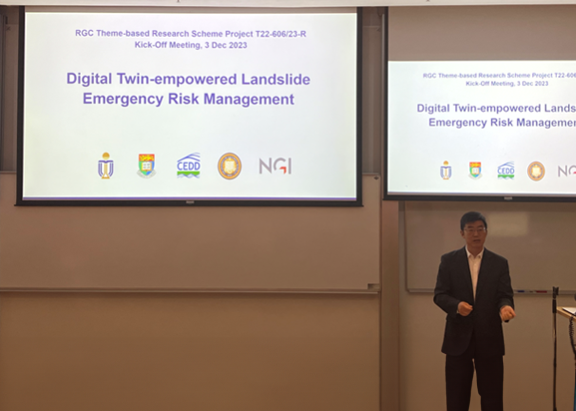
Funded by the Research Grant Council (RGC), the first progress meeting for the Theme-based Research Scheme, the Digital Twin-Empowered Landslide Emergency Management Project, was unveiled on December 03, 2023, at the Hong Kong University of Science and Technology. The meeting paved a 3-hour fruitful discussion on the project's goals and initiatives among its respected attendees. This kickoff meeting served as a key step to launch an effective collaboration between the project members and set a benchmark for the project's proposed research plans.
The theme-based research project aims to improve the disaster resilience of Hong Kong's slope safety system by introducing a new paradigm of emergency risk management in the digital scene. This venture envisions delivering a world-leading city-scale digital twin that rapidly detects landslides and coordinates the triggered societal response. This project guns to overcome the challenges of advancing from project-scale to city-scale simulations, extending slope-scale computations into real-time modeling, and incorporating dynamic risk-informed theory and social activity into emergency management.
Attendees
Spearheaded by Prof. Li Min Zhang, the kick-off meeting was attended by its multi-national and multidisciplinary team, consisting of experts in the fields of geotechnical engineering, emergency risk management, construction informatics, remote sensing, public policy, and computer vision. Representatives came from esteemed institutions such as The Hong Kong University of Science and Technology (HKUST), University of California, Berkeley (UC Berkeley), Geotechnical Engineering Office (GEO), Norwegian Geotechnical Institute (NGI), and Queens University (QueensU).
Some key attendees present were Prof. Jack Cheng, Prof. Bo Huang, Prof. Gang Wang, Prof. Kenichi Soga, Prof. Jidong Zhao, Prof. Jiujiu Jao, Prof. Chi-Keung Tang, Prof. Xun Wu, Prof. Te Xiao, Prof. Yan Tao Yu, Prof. Sheng Han Zhang, and Prof. He Jian. Each co-implementor delivered presentations regarding their task assignments and discussed their steps for research implementation. Prof. Raymond Cheung of GEO, Prof Suzanne Lacasse of NGI, and Prof. Jean Hutchinson of QueensU also made their presence and gave their helpful comments on each issue encountered by the team.
Agenda
The meeting agenda focused on the three main tasks of the theme-based project. Each task had a project co-implementor who outlined the objectives in detail, discussed ongoing efforts, cited previous related studies, and set challenges up for the whole project team's discussion. The scopes, limitations, budget, and timeline for each sub-task were also covered in the meeting agenda.
Task A involved constructing a remote sensing database for the digital twin, establishing a GIS-BIM model for slope systems, and creating a unified data network for sensing and communication in the real world. Task B was then focused on developing a multi-physics coupling platform for simulating landslide hazards, creating a data-driven nowcasting model for urban dynamics, and designing a computer graphics engine for simulating crowds. Finally, Task C was centered on end-users, as it aimed to expand the risk assessment framework to include not only terrain but also infrastructure and human responses.
Key Takeaways
For the benefit of all the stakeholders involved, a list of key points was raised and discussed during the meeting. One of which was the availability of satellite imagery and its currently low temporal resolution which is crucial in delivering real-time simulations. In response, the project team planned to address this by utilizing the latest deep learning frameworks available. Additionally, the project team also ensured that no resources would be put to waste and emphasized the importance of proper budget utilization, especially in procuring equipment. Handling data privacy was also carefully discussed as it is a major concern for data-intensive projects such as the digital twin. The project assured that data confidentiality will be put as a priority. Prof. Li Min Zhang also emphasized on the importance of conducting international workshops and building student collaboration among institutions to further promote the initiatives of the theme-based project.
Project Timeline and Next Steps
Since the project's inception in January, a website that serves as a communication tool for the project was already in development. This site will showcase the research team, research scopes, digital products, task progress, and the latest news about the theme-based project. The project timeline will span from the start of 2024 to the end of 2028. During this period, it will intend to conduct regular progress meetings, student exchange programs, advisory board meetings, international workshops, industry training sessions, and policy advice.
The kickoff meeting ended with an acknowledgment of everyone's attendance and contributions. In conclusion, the meeting set the foundation for a successful project by setting the necessary goals along with a sound timeline. Prof. Li Min Zhang reiterated the importance of collaboration and communication towards achieving each of the project's initiatives. With the help of the talented and skillful people under this project, the rise of a world-leading digital twin for landslide emergency management is conceivable in the foreseeable future.